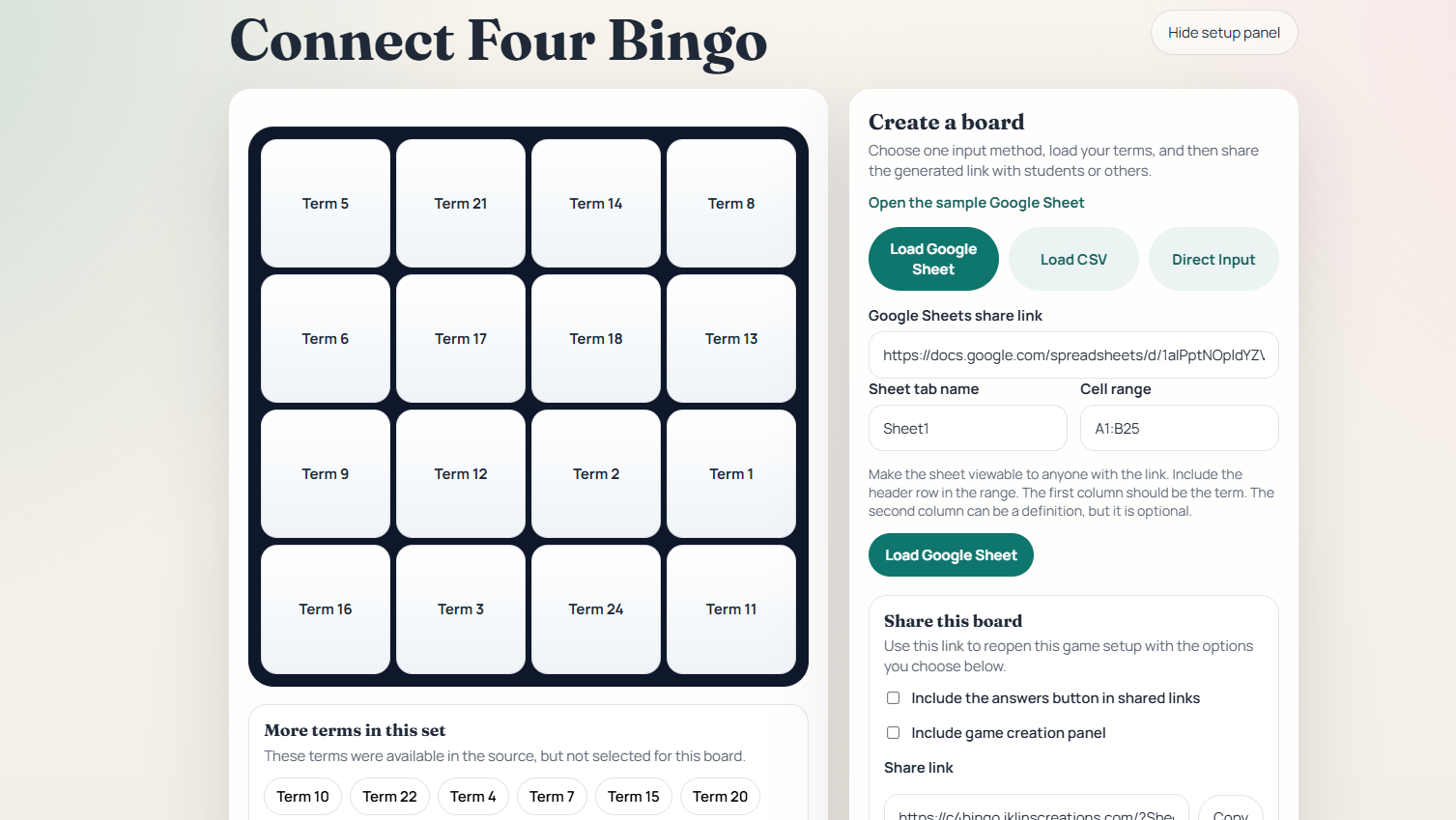
This is actually a remake of a project I did in 2020. Back when I started teaching computer programming, I threw together a quick application that would allow me to host bingo style games in my class by giving the students a link to a page that would load terms randomly in a 4×4 grid, then I would read definitions and they would click the terms on their board as they had them. This led to nice discussions among the students about what term I was describing and added a bit of fun to vocab review. The application was written to load from an excel file or from a google sheet so I didn’t have to rewrite any code each time I wanted a new game. It’d just plug in the input file and it would give me a link I could give to the students.
Here’s an image of the old system:
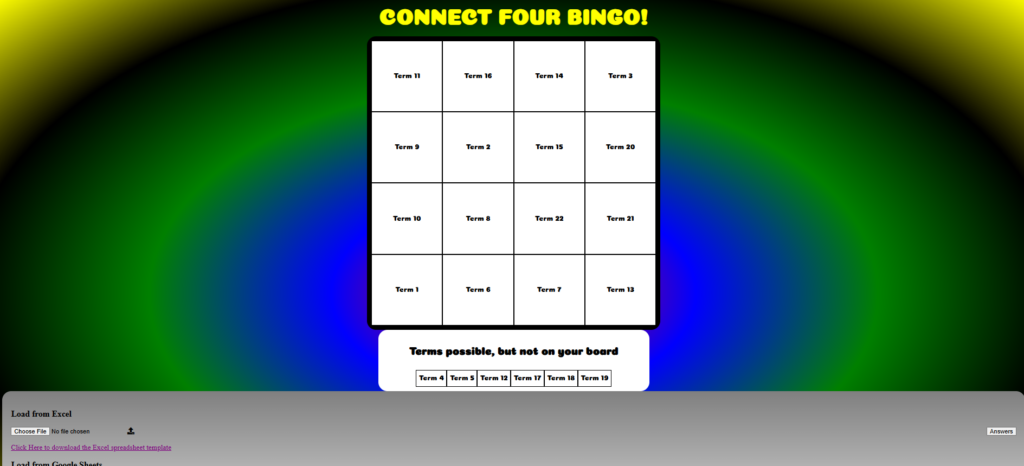
This is, admittedly, not the prettiest page in the world, but it worked for my purposes, and if I’m being honest, I don’t always enjoy writing css.
As time went on, I started finding new ways to enjoy the bingo game, specifically, without worrying about definitions. I created boards for faculty meetings so teachers could play on their phones as administrators talked. We’d keep our ears open for words we heard frequently such as “triage”, or “piggyback”, or “pivot”. It seemed to add an element of fun to the meetings. Admittedly, I was a little spooked when our director caught wind and led me to believe I was to be disciplined for it…but he actually took it in good fun and we had a laugh about it.
Years had passed and I found myself in church with the family one day when I realized it could be used here too! It’s always a bit tough keeping the kids from stirring, or getting them to listen during a sermon, so one day before the sermon I hopped on my phone, made a quick list of common “sermon words” in a google sheet and loaded the game on my phone for the kids to play. It actually seemed to work. They would play the game, ask each other what was just said and follow along. I can’t say that they took the meaning from the message, but maybe it was better than just stirring and waiting for it to be over….and truthfully, I was looking over their shoulders playing too.
Now enter my phase with OpenAI’s Codex. Aside from my existential crisis of what I should teach or what should be done to prepare to be a developer these days, I am absolutely loving playing with it. It’s so easy to create an application in a few short hours that would’ve taken me weeks (or more) in the past…this has really got me revisiting what the role of a software engineer actually is, which (to me) is a person who solves problems and introduces solutions and innovations. Perhaps that role isn’t going anywhere, but I sure am concerned about the straight “code monkey” role that has always been out there…but I digress.
In thinking about that connect four bingo app, I have hated the look of it for quite some time. Plus, there were some functionality pieces I would’ve liked, but they were never really worth the time to dig back in. Since I’ve been having fun with Codex lately, I figured I’d pull down the repo and chat out a full rebuild.
I (well, Codex under my direction) added functionality to just directly input terms, open a new window for printing multiple boards (I thought this would be good if the pastor at our church wanted to lean into it a bit), cleaned up the appearance and did a few other small tweaks to application. Then I deployed it to railway. It can be seen here (populated with html terms, the optional ability to view answers and see control panel turned on) : https://c4bingo.jklinscreations.com/
Here is a sample link that is used in church (just words, no answers/definitions with the control panel hidden).
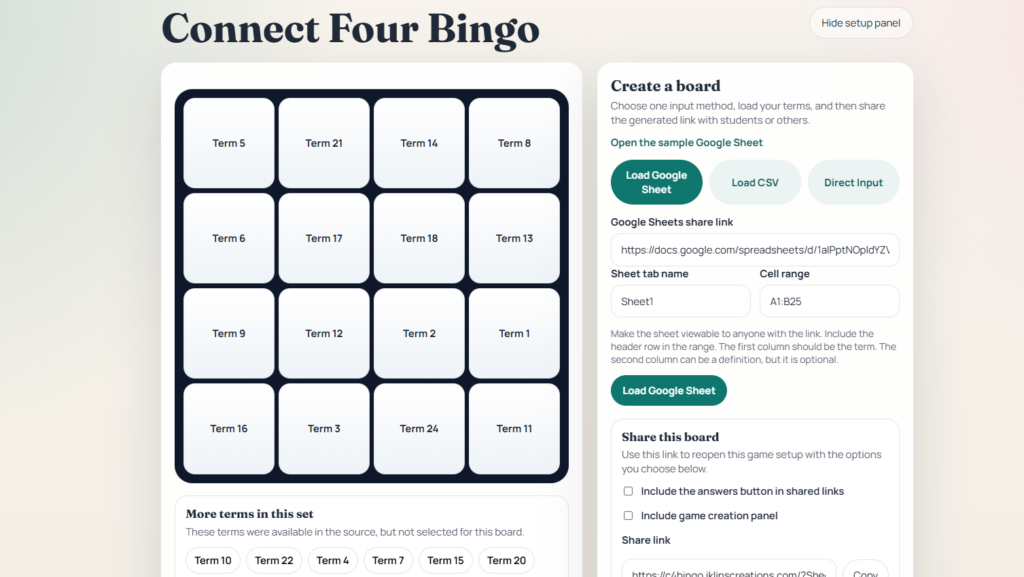
Here’s just a shot of the new application because everyone likes pictures:
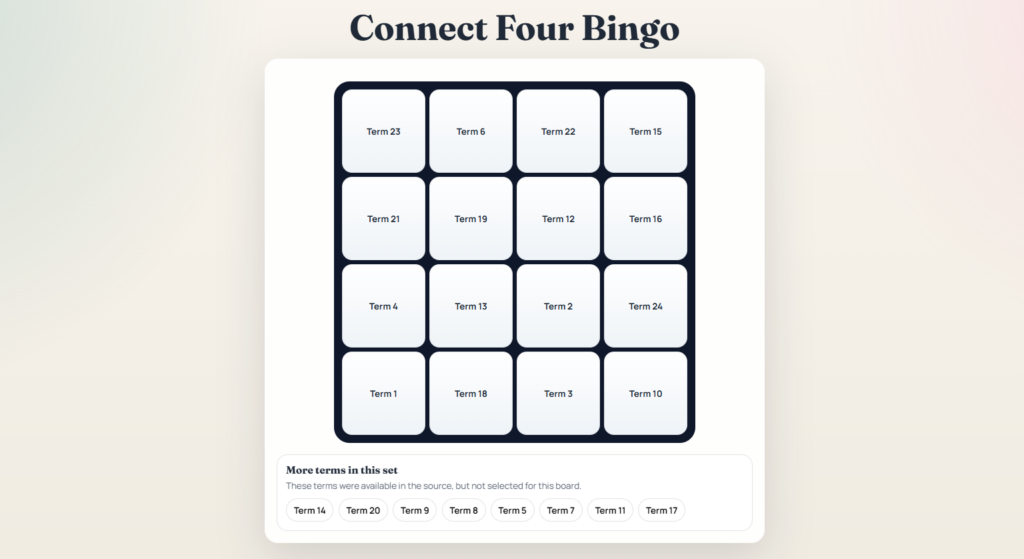
…and if you play with just the board:
I’ve contemplated tying sockets in to create rooms and announce winners, but I don’t know if I’ll ever go there with it or not.
Anyhow, I just wrapped up the update on the application and I’m trying to build a habit of posting things on this site, so I thought I’d put a note about it here. If anyone ever reads this, maybe they’d like to try it for themselves in a church or meeting or classroom setting.

Leave a Reply